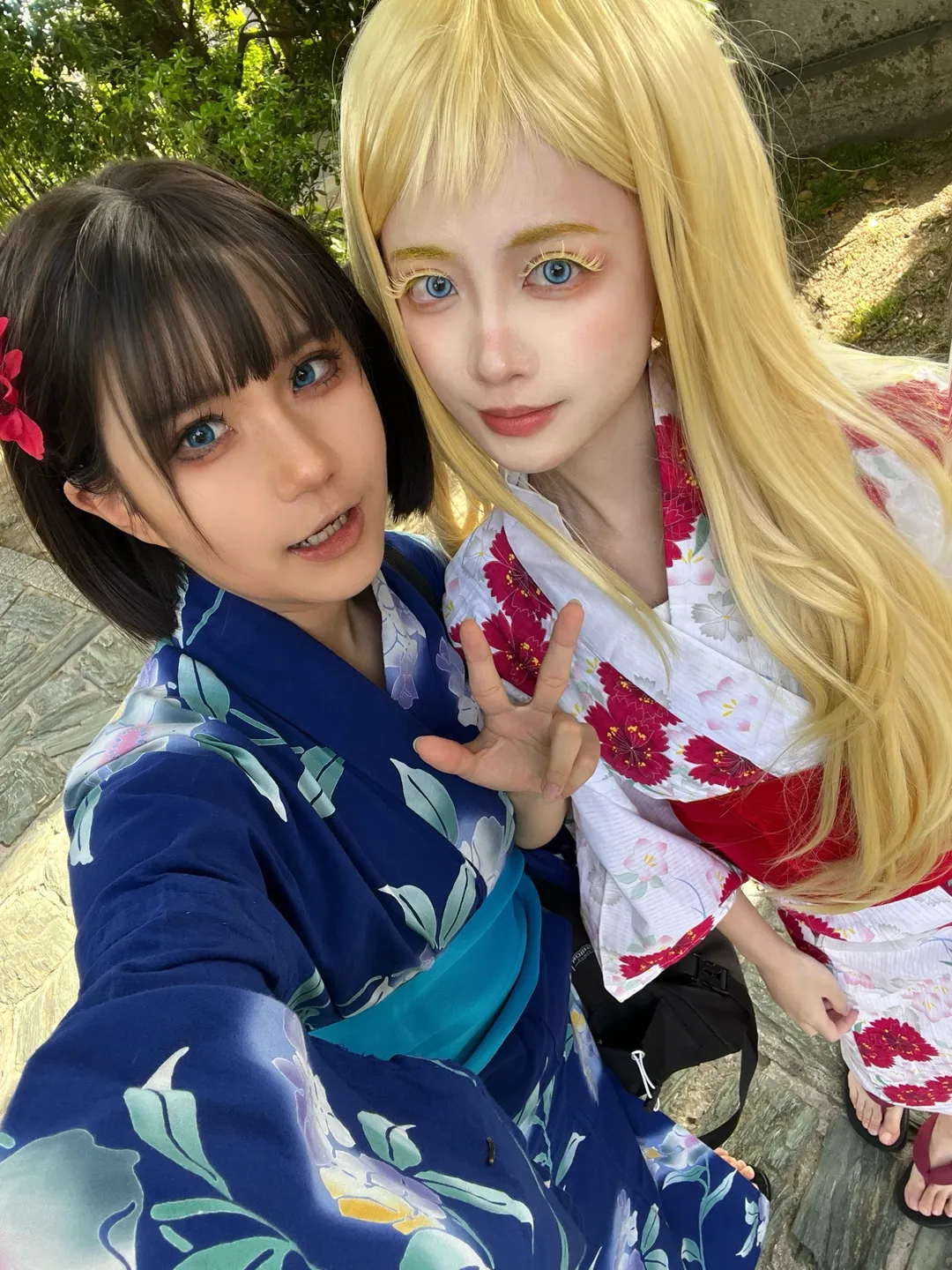
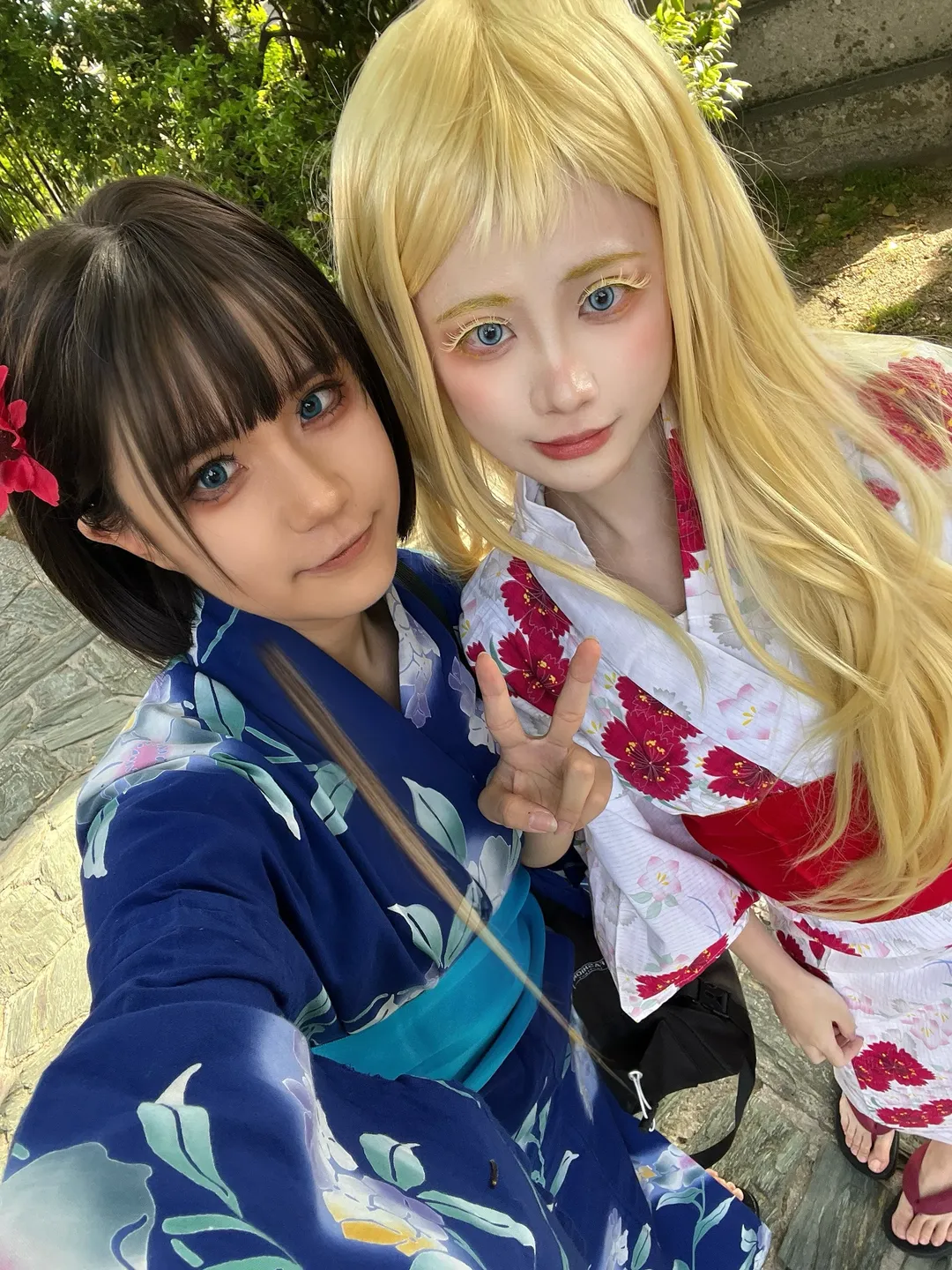
For this Summer Time Rendering Anime pilgrimage during our Travel to Japan, we set the location directly in Kushimoto, Wakayama. To stay faithful to the original designs of Ushio Kofune and Mio Kofune, we made clear distinctions in styling and costumes. For the blonde sister, we chose a Japanese style Yukata featuring red peony patterns on a white base, paired with light blue contacts and yellow eyeshadow; the makeup saturation was kept low to emphasize her translucent radiance. For the dark-haired sister, we chose a deep navy Japanese style Yukata patterned with green leaves and flowers, accented with a red hair accessory, leaning towards a cooler palette overall. During preparations, we tested several versions of the base makeup alone; because summer UV rays are intense, we applied a heavy layer of waterproof and sweatproof setting spray so that even if the bangs stuck to the forehead with sweat, the base wouldn't become patchy.
To keep the blonde wig's bangs fluffy without obstructing the eyes, hair wax was carefully worked into the roots, finished with hairspray at the tips. The black wig was styled using a flat iron to curl the ends inward, which, paired with blunt bangs, accentuated a sweet, well-behaved charm. The two pairs of light blue contacts were also selected with precise graphic diameters to reflect bright clarity under direct sunlight. When wearing a Yukata, the tightness of the obi sash is crucial: if it's too loose it easily falls apart, but if it's too tight you can barely sit down. The sash on the blue outfit was a wide cyan fabric band that required tying into a relatively firm bow to maintain proper support.
When taking selfies on the stone paths in the park, we tried angling the lens slightly lower, using a medium close-up framing to ensure both of us were framed right in the center. We utilized the hard light filtering through the tree canopy to contour our facial profiles, keeping our gaze centered on the lens. The phone selfie camera used a wide-angle lens; standing near the edges causes stretching and distortion, so we deliberately leaned toward the center to stabilize the visual weight of the frame. We interacted with hand gestures and eye contact during selfies, snapping over a dozen continuous backup shots in one go.
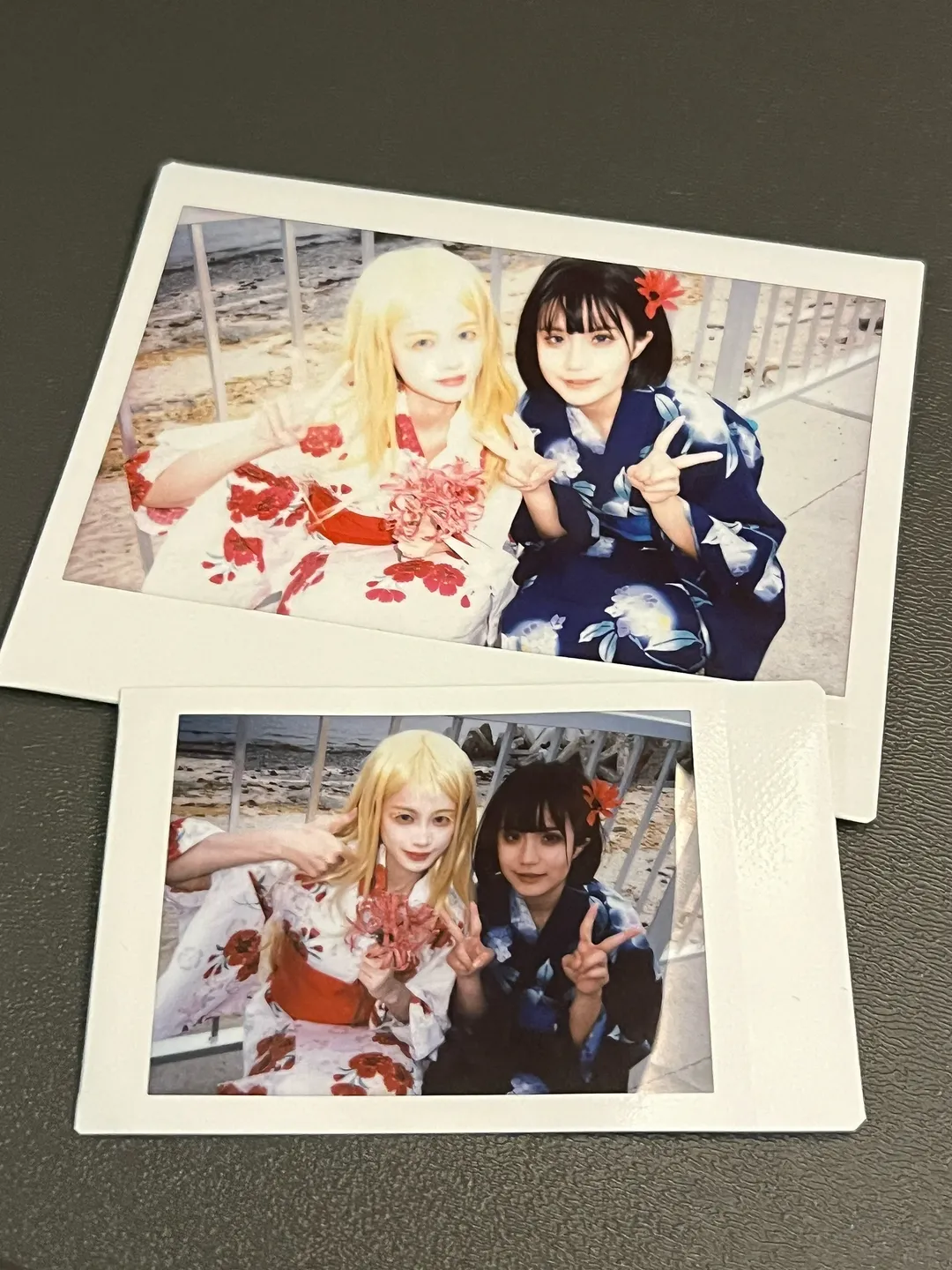
Because Polaroids don't allow manual shutter adjustment, we tried to avoid midday sunlight when shooting by the coast, utilizing shadows cast by metal railings as transitions to meter the white balance. Reflections from the seaside railings were tricky—we failed to avoid them in several shots before learning to lower the camera angle and block part of the harsh glare with our bodies. Strong sea breezes easily mess up hairstyles, so the trick was ensuring the wind blew our hair in a uniform direction the moment the shutter clicked to create an organic dynamic effect. Also, re-photographing Polaroids causes severe glare; the best approach is waiting until the print fully dries, laying the photo paper on a dark matte desk, and finding the right angle to shoot.
Walking along stone paths in wooden geta clogs was actually quite cumbersome, and wearing a tight obi sash in summer made taking deep breaths challenging. But seeing the final results—especially that vintage, naturally warm patina of Polaroid film—made it all feel worthwhile. In the story, Ushio Kofune and Mio Kofune are sisters, so we kept our poses as natural and intimate as possible, such as leaning close together with V-signs, looking just like a pair of sisters enjoying a summer outing. The shooting vibe was lighthearted; chatting and touching up makeup made the time fly by. We briefly took shelter under the shade of trees due to the intense sun and reapplied sunscreen twice. The whole process flowed with unspoken synergy without wasted movement, nailing shots on the first try. Looking at the two physical photo prints in hand, they serve as the most authentic mementos of this Travel to Japan.