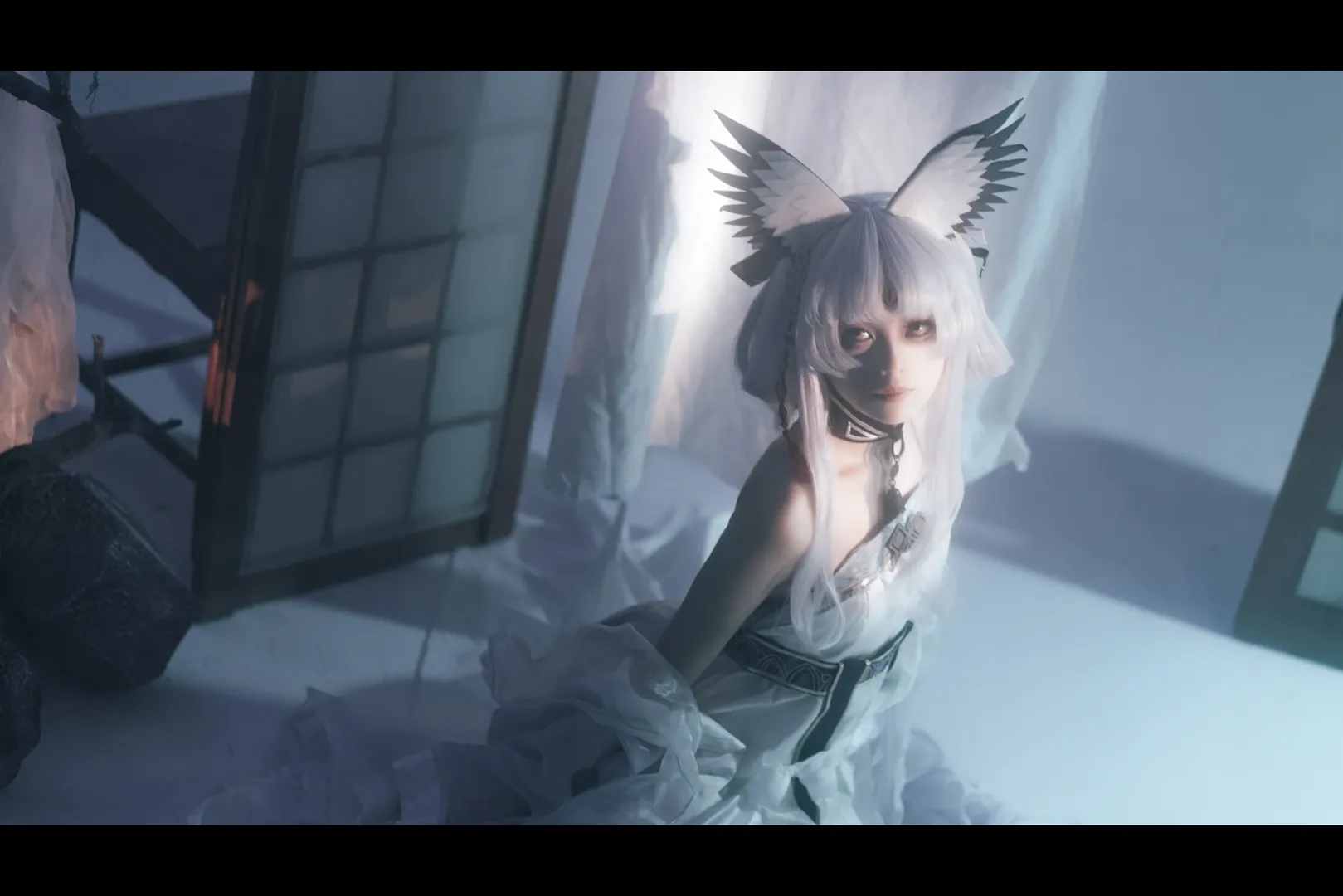
When shooting this Ptilopsis cosplay set from Arknights, the sheer volume of communication needed for pre-shoot prep and on-site adjustments was immense. Regarding the costume, to capture that light, airy yet slightly mechanical feel from the original design, I specifically commissioned a tailor to custom-make this white tulle dress. This fabric has excellent light transmission under backlighting, highlighting the skirt's rich layers, but the downside is that it wrinkles very easily. During the shoot, an assistant had to constantly smooth out the hem from out of frame, while I had to carefully manage my sitting posture to avoid crushing the layers. The wing prop on the headpiece was made of acrylic with a metal frame; securing it was tricky, as any slight tilt while leaning forward or turning back looked stiff, and its substantial weight posed quite a test for my neck. To maintain natural strand definition in the silver-white wig, I brought two spares that day, as this color easily gathers dust or yellows if accidentally oversprayed with hairspray. For makeup, beyond wearing large-diameter pale colored contacts, the emphasis was on sculpting facial features with contouring and highlights under cool light to look three-dimensional yet calm and composed, mimicking the character's machine-like tranquility in this Outfit details sharing log.
Special thanks to Fuyunjian and British Archwitch for this shoot. The lighting setup was intriguing: the key light was placed behind me to create strong rim backlighting, tracing the contours of the hair and wing edges, while the face relied entirely on diffuse ambient light. Not lighting the face directly gave the gaze a deeper, more organic feel. The background blended Japanese-style shoji doors with draped sheer curtains; warm lighting contrasted with the cool primary palette, cleanly isolating the character's emotion from the environment. During shooting, managing the gaze was crucial—looking away from the camera or holding a slightly unfocused stare fit the character much better. In post-processing, I preserved this cyan-blue cool tone without overly boosting saturation. Since much of the frame consisted of white tulle and light walls, poor highlight control would cause crushed whites, so tone curves and masks were used to compress overall exposure. Overall, this project pursued a cool, serene, dreamy, yet subtly melancholic ambiance through Cool-toned photography. To ensure high photo output, we scouted locations multiple times; considering the outfit would easily get dirty outdoors, we opted for a semi-indoor set with artificial lighting for theatrical flair. My biggest takeaway after finishing this shoot is that an exceptional cosplay piece never depends solely on a single frozen frame—from garment pattern-making and blocking to lighting calculations and color grading, every detail embodies the hard work of many people. Though the process was grueling, the resulting lighting layers and character portrayal hit the mark, truly justifying the effort invested into preparing these props and costume.