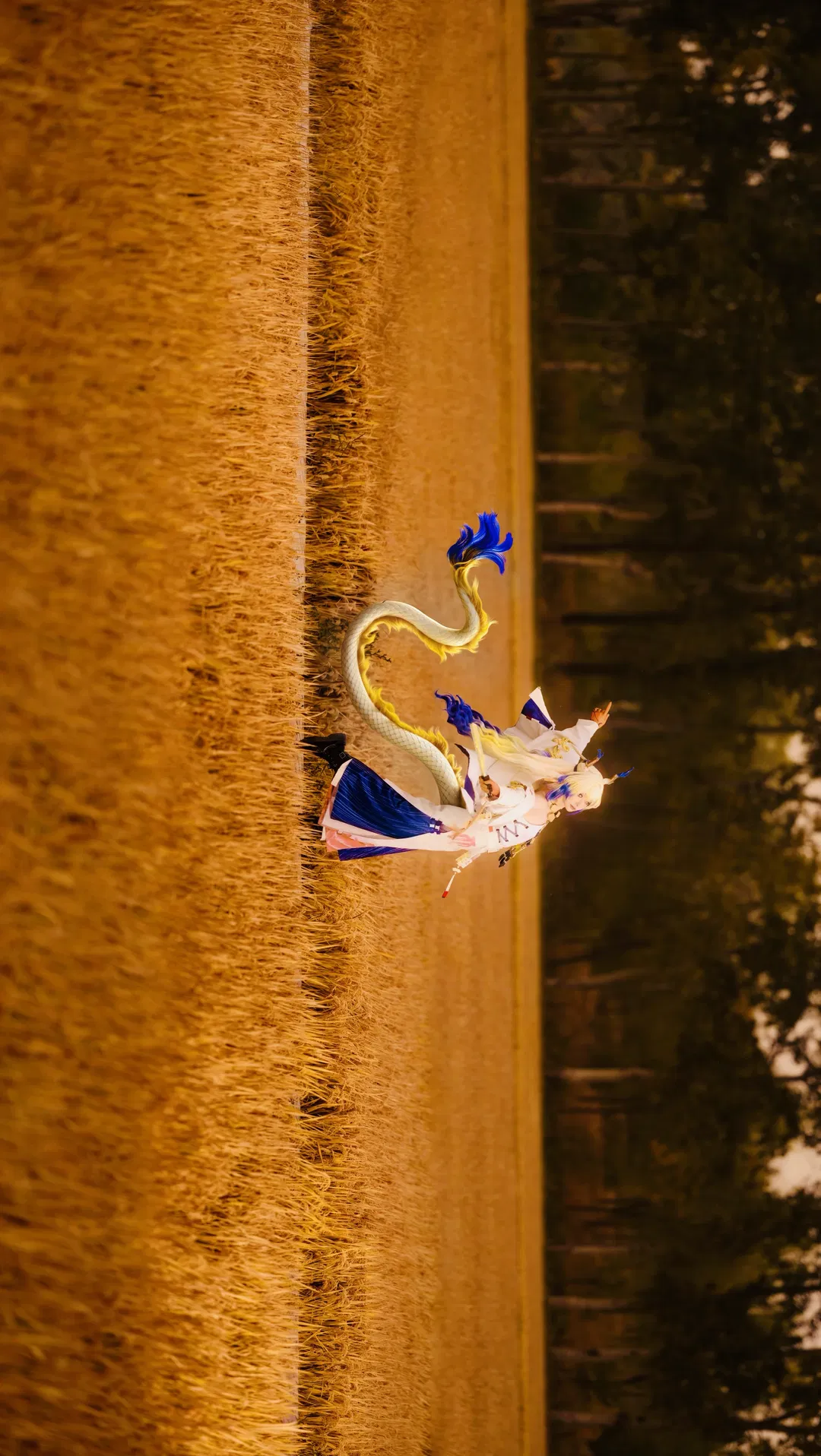
This time, a lot of effort went into retouching, and seeing the final result is truly fulfilling; it's also one of my favorite photos recently. The concept behind the entire shoot was to create a visual contrast by placing traditional fantasy elements into a real-world setting. To catch the orange light of the golden hour during dusk, we waited for a major part of the day in the wilderness. The wind in the silvergrass field was very strong, blowing the skirt hem and hair out of control. This costume has a very large silhouette, and the white-and-blue-bordered color scheme tends to look flat under natural light. Therefore, during post-production color grading, I purposely darkened the dark forest areas in the background, creating a dual contrast of cool-warm tones and light-and-dark, drawing all visual focus entirely onto the character and the dragon-shaped special effects behind. Regarding lens selection, a medium-to-long focal length was used to compress space, making the distant forest appear closer and more oppressive, thus making the subject stand out even more.
The presentation of this dragon was the biggest challenge this time. The physical semi-transparent prop looked a bit flat under backlighting, so I simply layered textures in post-production, adding high-saturation bright blue petal-shaped light effects to the tail end, making it pop out from the golden background. Following the S-shaped curve of the body actually guides the viewer's gaze toward the face, coupled with the character's dynamic raised hand, which breaks the balance of the frame and gives the static photo a sense of tension. The blue on the skirt hem echoes the dragon's tail, and the color blocks of the entire image consist of a large area of yellow background dotted with white and blue, which is very pleasing to the eye. When handling post-production for cosplay with such complex backgrounds, the refraction of ambient light and the masking around the edges of the subject are the most exhausting parts—especially the blending of semi-transparent materials, which requires hand-painting details bit by bit, otherwise it looks very fake. One also has to consider the morphological changes of clothing wrinkles during movement; although it is a static image, the flow of the fabric must comply with physical laws as much as possible. To this end, during retouching, I pulled the original image into software for local perspective adjustment to make the extension from the waist to the skirt hem smoother.
The light in the wilderness slanted down, and the grass fluff formed a grain-like texture in the lens. I feel that creating subtle dynamics within a grand environment gives more narrative depth than a simple studio shoot. The rustling sound of the wind blowing through the grass, combined with the on-site styling, truly gives a sense of dimensional reduction. When portraying this character, I value the details of the headdress and hairstyle very much, because characters with divine attributes or fantasy colors often do not need exaggerated facial expressions; instead, they convey the character's composure through bodily extension and lines. The makeup was also minimized, emphasizing bone structure, paired with warm light to exude an earthy, steady composure. Throughout the retouching process, I tried my best to preserve the true texture of the skin without excessive smoothing, and the parts where ambient color spilled were also preserved using layered color grading, wanting to present the texture of real light and shadow casting on the body. Although some technical details were tedious to handle—such as the rim light on the dragon horns under backlighting, which needed to be extracted separately and brightened—the light-and-shadow atmosphere and texture in the final image both met expectations, successfully expressing the vitality in the wilderness that the character demands.