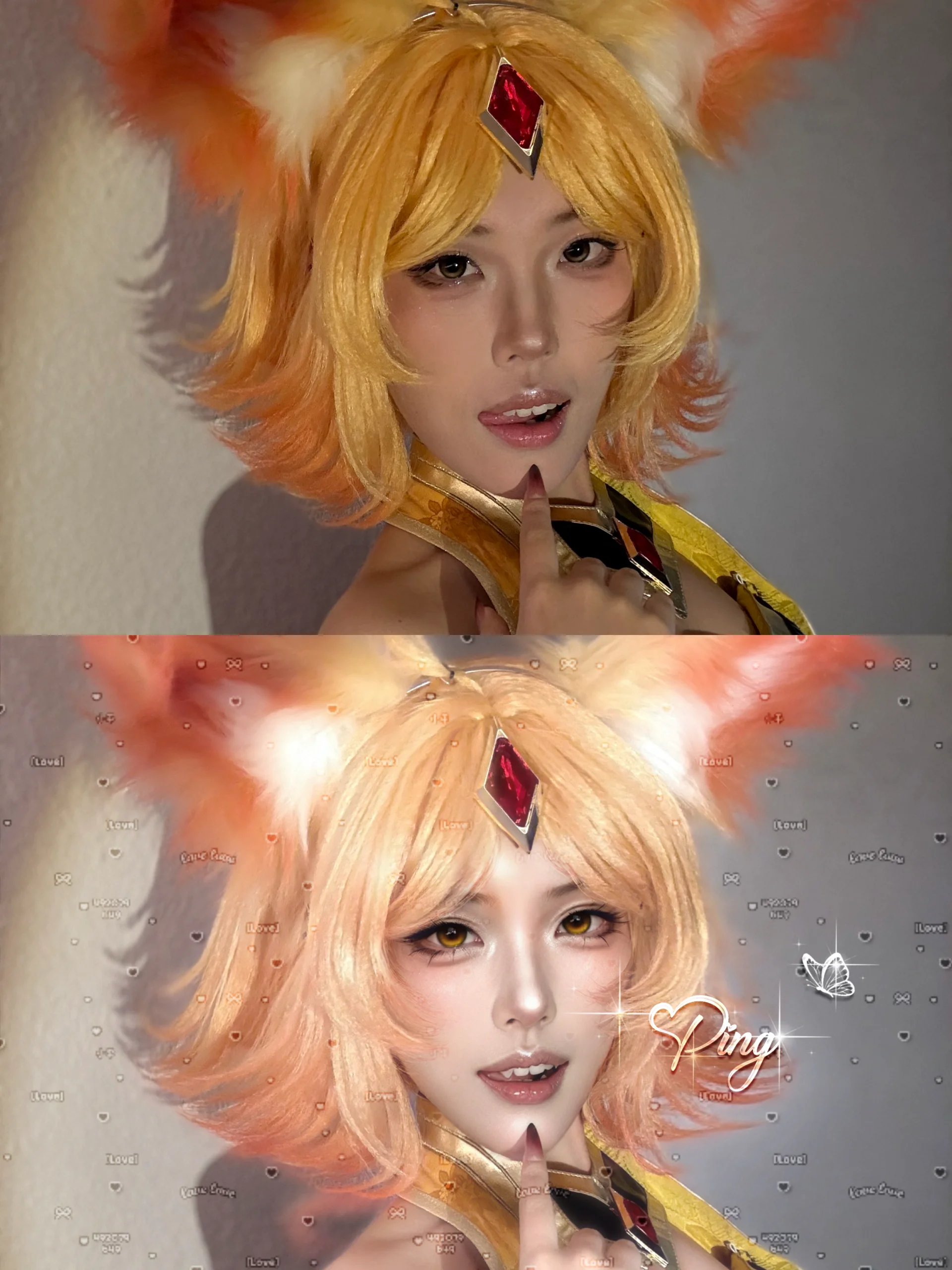
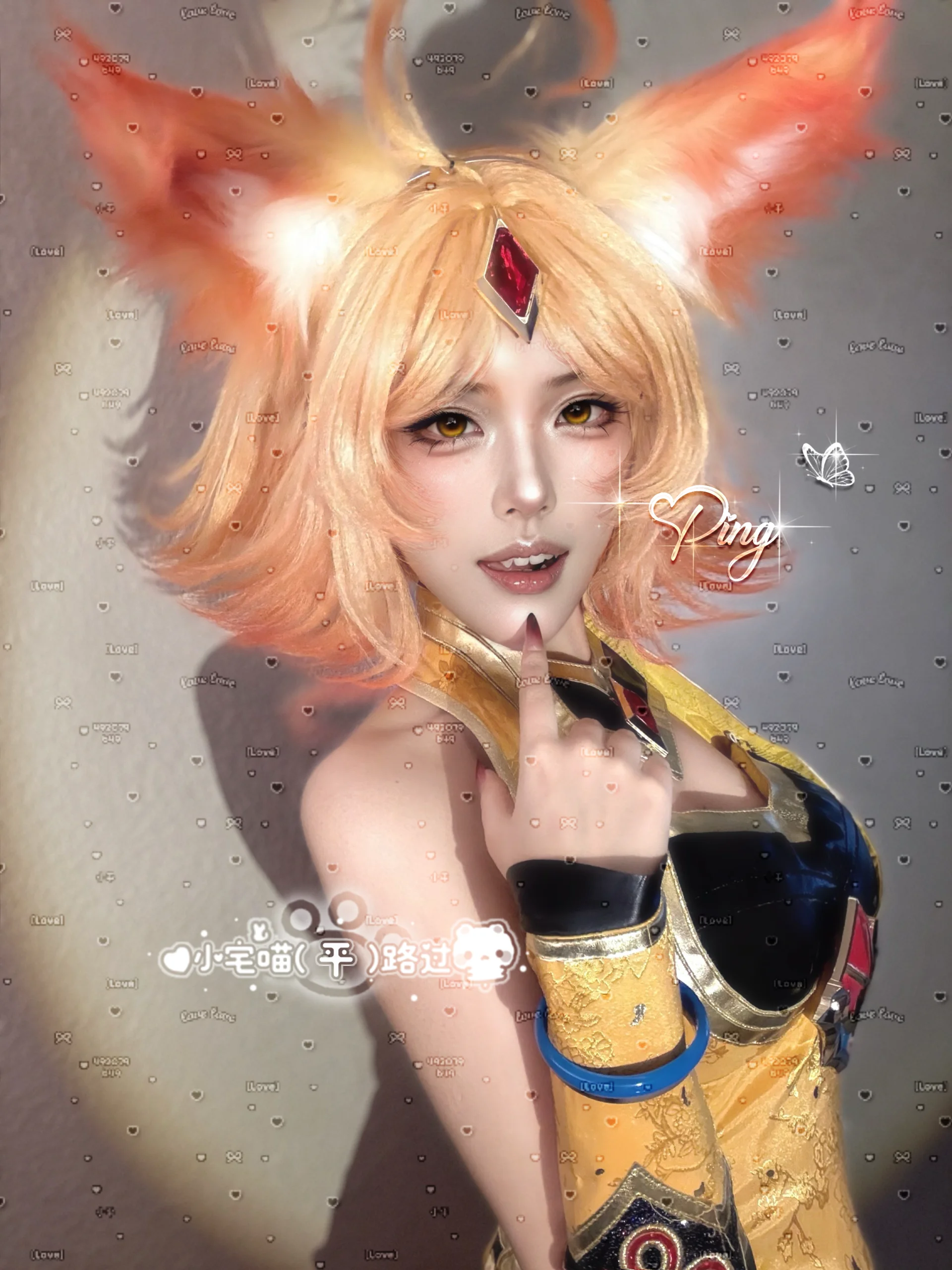
The main focus of this set of photos with orange animal ear styling lies in the unification of costume colors and the construction of light and shadow during post-processing. Natural-style thick painting isn't about heavy skin smoothing or liquefaction; rather, it’s a hand-painting approach used to supplement highlights, shadows, and color layers on top of the original photographic plate.
In terms of specific operations, the first area I processed was the texture of the wig. Because the wig styling itself is quite fluffy and possesses a certain level of natural frizziness—which can appear messy on camera—I used a brush with semi-transparent edges to stack bright yellow and white highlight lines, following the direction of the hair strands. These highlights shouldn't be drawn too rigidly; the pressure of the brushstrokes needs adjustment according to the curls of the hair to achieve a three-dimensional effect reminiscent of 2D hand-drawings without losing the natural posture of a real person.
The animal ear accessories are the highlight of this set. The textures of the fluffy edges and the internal ruby headpiece are completely different. For the animal ears, I applied a large area of soft, glowing halos to overlap, blurring the原本 (originally) crisp plush edges to create a soft, diffused light effect. For the ruby on the forehead, I adjusted the color saturation and edge sharpness to create a hard, reflective surface, forming a visual contrast between soft and hard.
Regarding facial treatment, I intentionally preserved some real bone shadows of the character, such as the area under the eyes and the sides of the nose. Overly smooth skin reduces the sense of naturalness, so during the thick painting flow, I used an eyedropper tool with low opacity to transition the surrounding skin tones slightly, then focused on drawing the clarity of the eyeliner edges and the light reflections on the lips. The action of the finger resting on the lower lip serves as an excellent visual anchor; I subsequently added contour light along the edge of the finger, allowing it to echo the highlights on the costume.
Looking at the clothing part, although the main body is bright yellow, there are black patches on the close-fitting areas, and blue rings worn on the arms. During the thick painting process, I specifically strengthened the dark areas of the black patched zones to make the yellow sections stand out more. As the only cool-toned element in the frame, I slightly increased the brightness of the blue rings and painted a small highlight reflection point on them, allowing this cool color to ground the overall warm atmosphere and increase the authenticity of the accessories.
The processing of the lower-body garments and wrist guards mainly focused on manifesting the metallic texture. Through the叠加 (overlay) of layer blending modes, I utilized high-bright golden yellow to depict the luster of the skirt hem, and accented details with deep red. This color grading logic is common in thick painting—using localized color enhancement to replace broad filter overlays. The benefit of this approach is that when you zoom in on the image, the texture boundaries of skin, hair, and clothing remain crisp rather than becoming a blurred mass.
Furthermore, the integration of environmental glow elements is also crucial. A large number of heart shapes and English characters were used in the images for atmospheric rendering. I used the 'Screen' and 'Soft Light' blending modes here to fuse the background sticker materials with the main tones of the frame. To prevent the stickers from appearing as if they were floating on the surface, I reduced the opacity and used a blur tool to soften the junctions between the stickers and the background, letting them reveal the original greyish-white tones of the background.
Comparing the two versions of post-processing, one can clearly see a qualitative improvement in the clarity and contrast of the frame after the natural-style thick painting treatment. This post-processing method is well-suited for styles featuring bright colors and a large volume of plush and metal accessories, as using common filter groups alone tends to lose the layers of the frame, turning rich-colored clothing into flat color blocks. Thick painting, conversely, allows for targeted enhancement based on different textures.
No complex lighting positions were used during the shoot, primarily relying on main lights from the front and front-side to produce highlight points. The natural-style thick painting in post-processing largely compensated for the monotony of the original environmental light, giving the frame richer visual layers. As long as one manages the control of the light-and-shadow boundary lines well during the post-processing flow, the original playfulness and liveliness of this styling can be well-preserved.
Integrating the overall skin tone and environmental light is also key to natural-style thick painting. I didn't adjust it into an overly artificial, pale cool tone, but maintained the base color of yellow-toned skin, and subsequently brightened the skin tone during post-processing to make the overall complexion look healthier. The background is greyish-white; after adding those hearts and light rings, it beautifully accentuates the subject status of the character. This processing method not only increases the atmosphere of the frame but also helps hide some uneven light spots in the background.