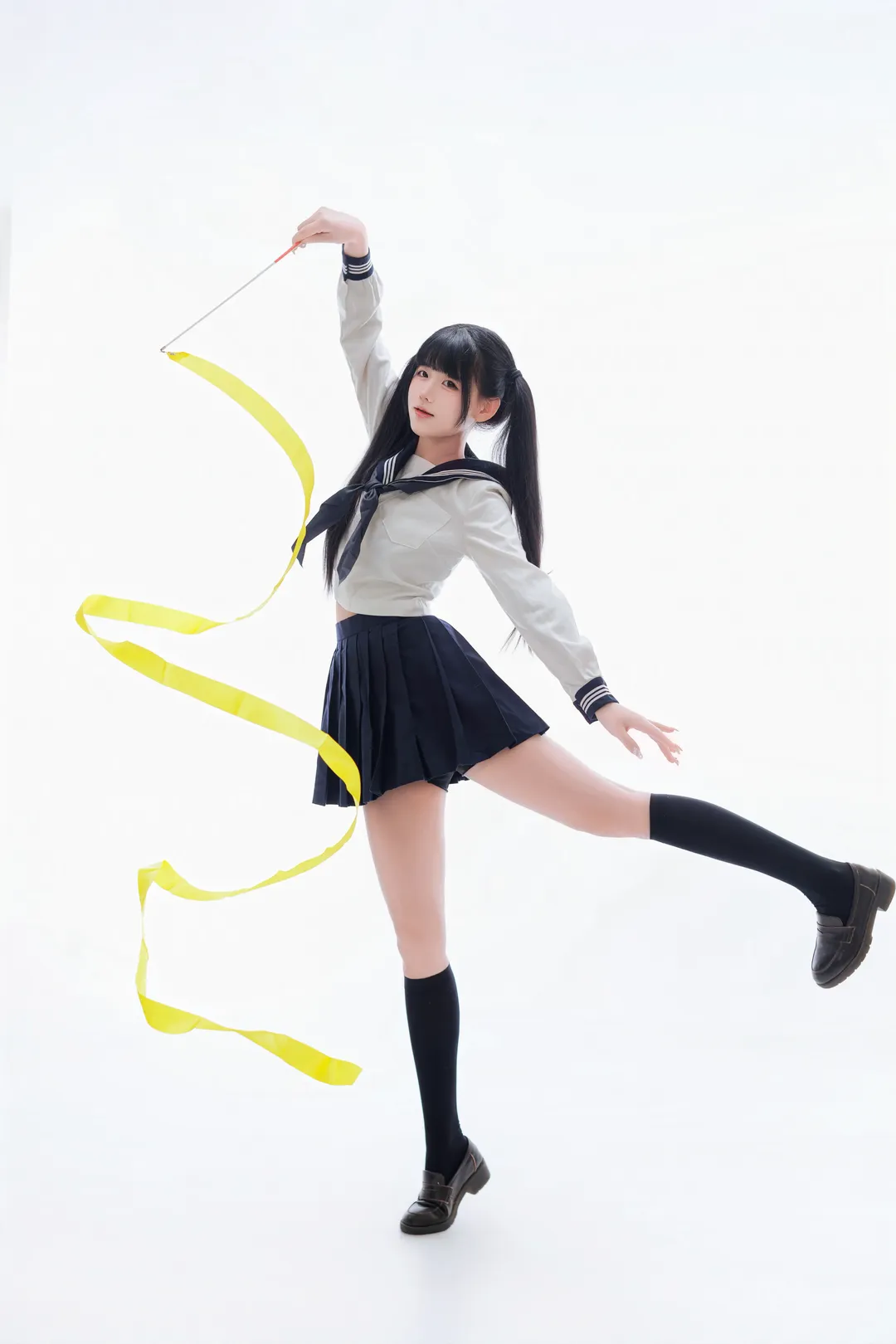
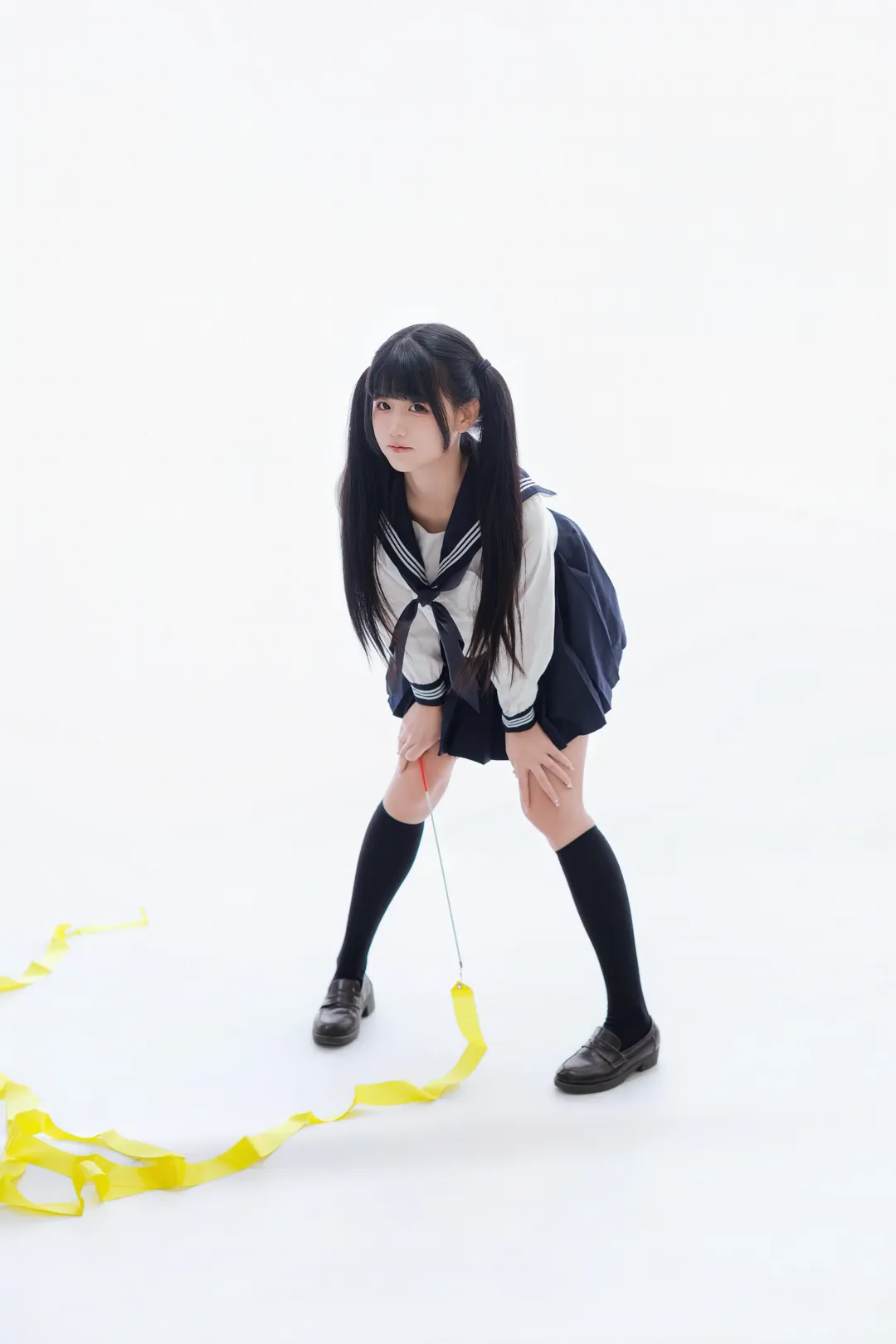
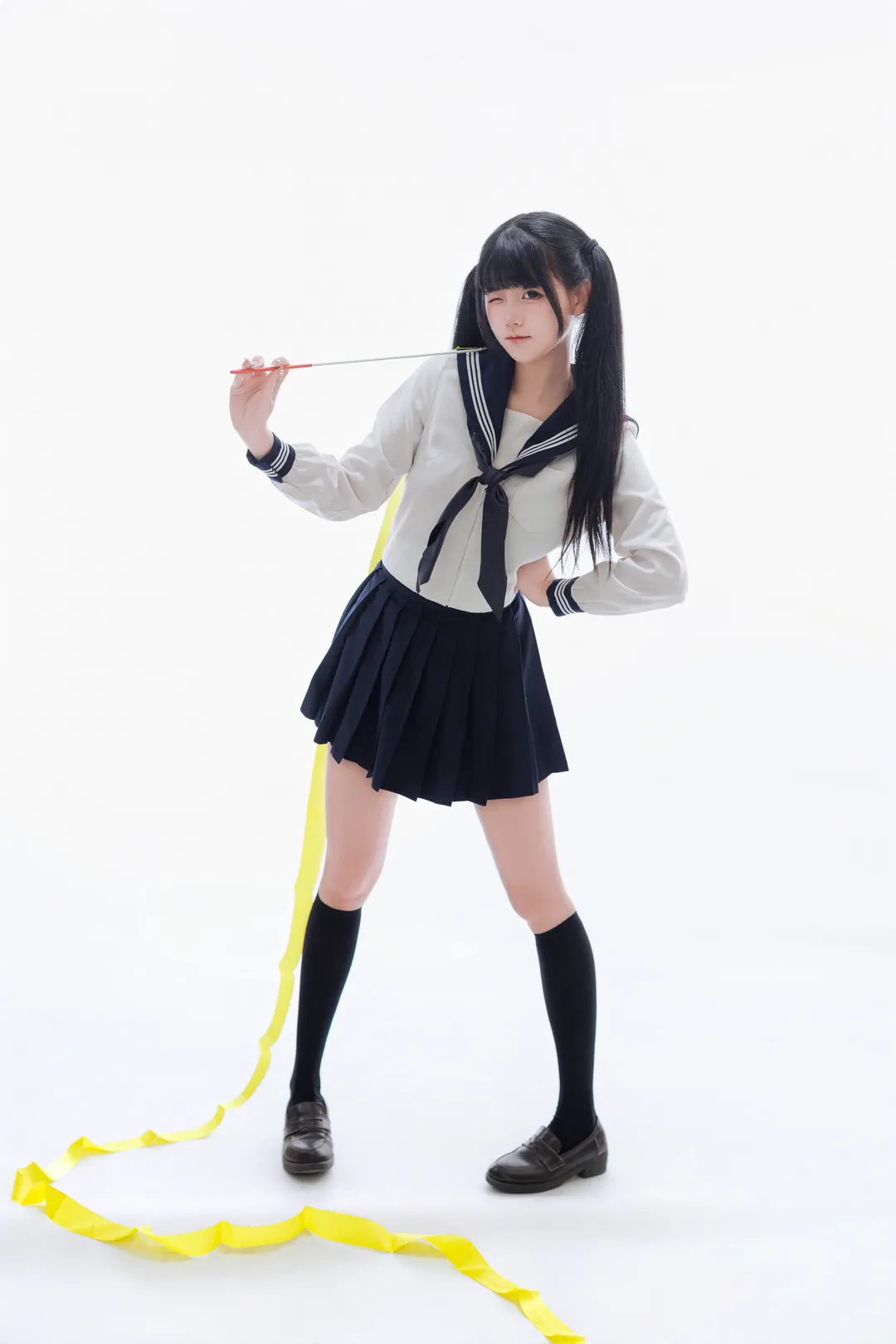
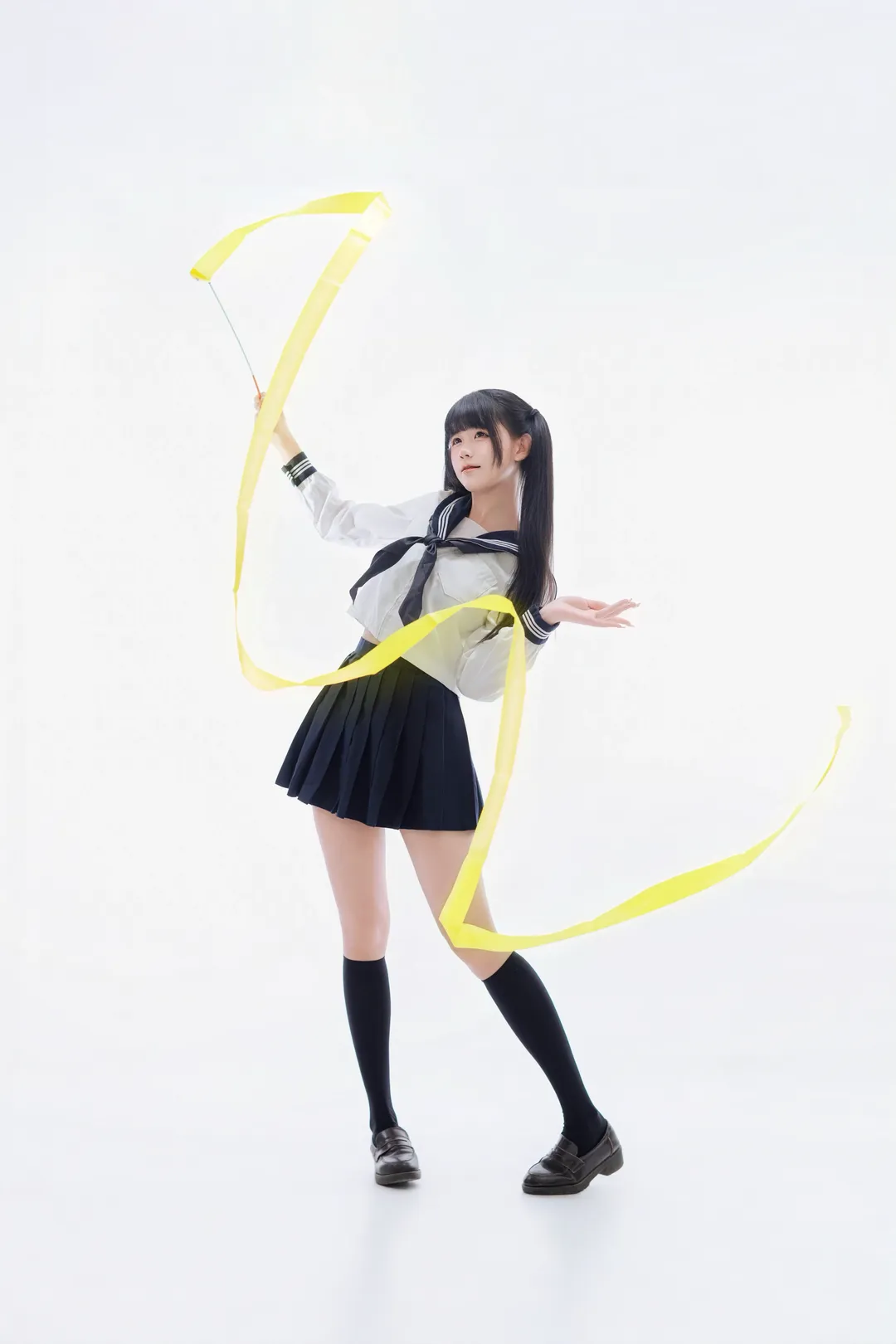
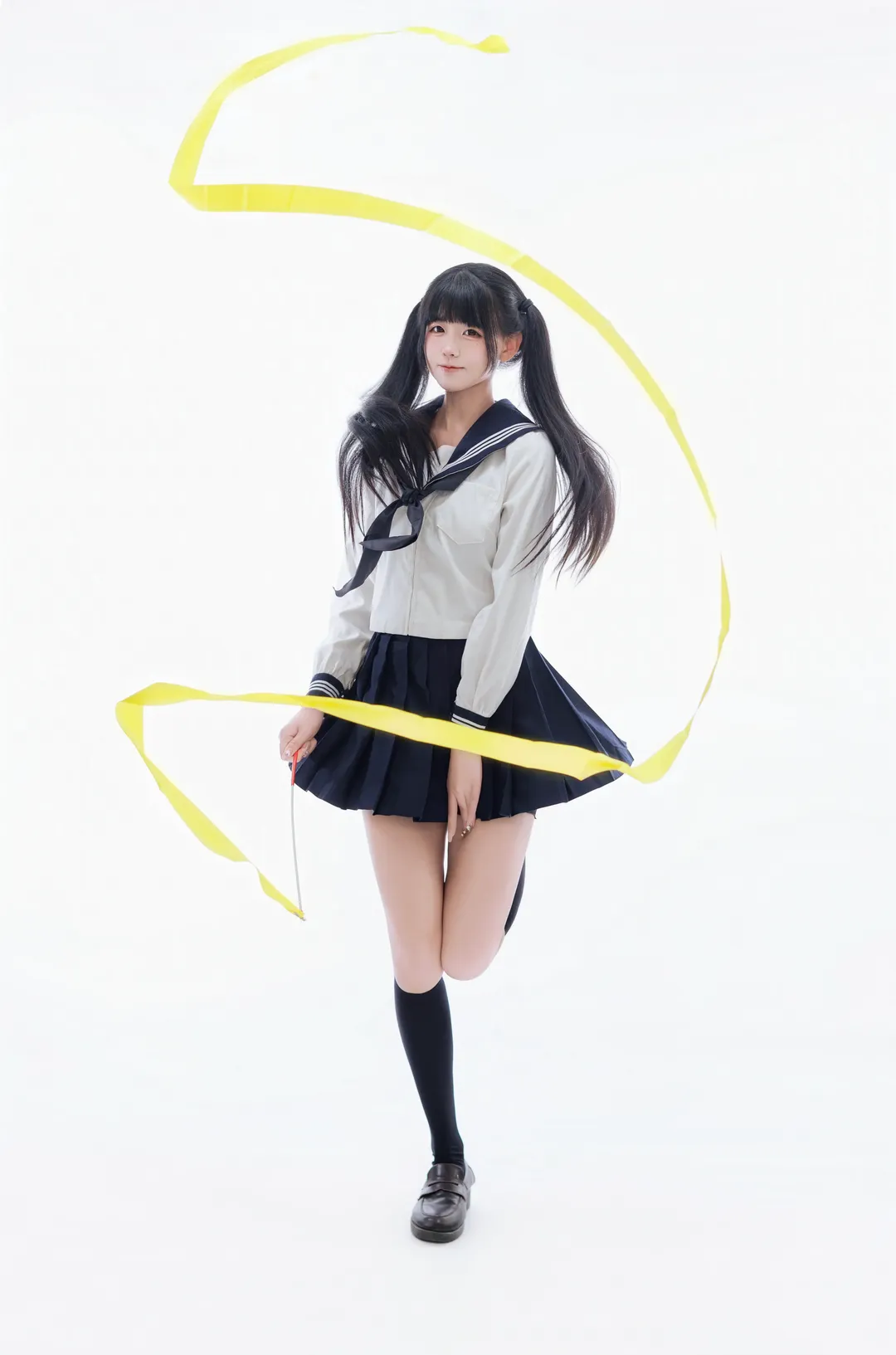
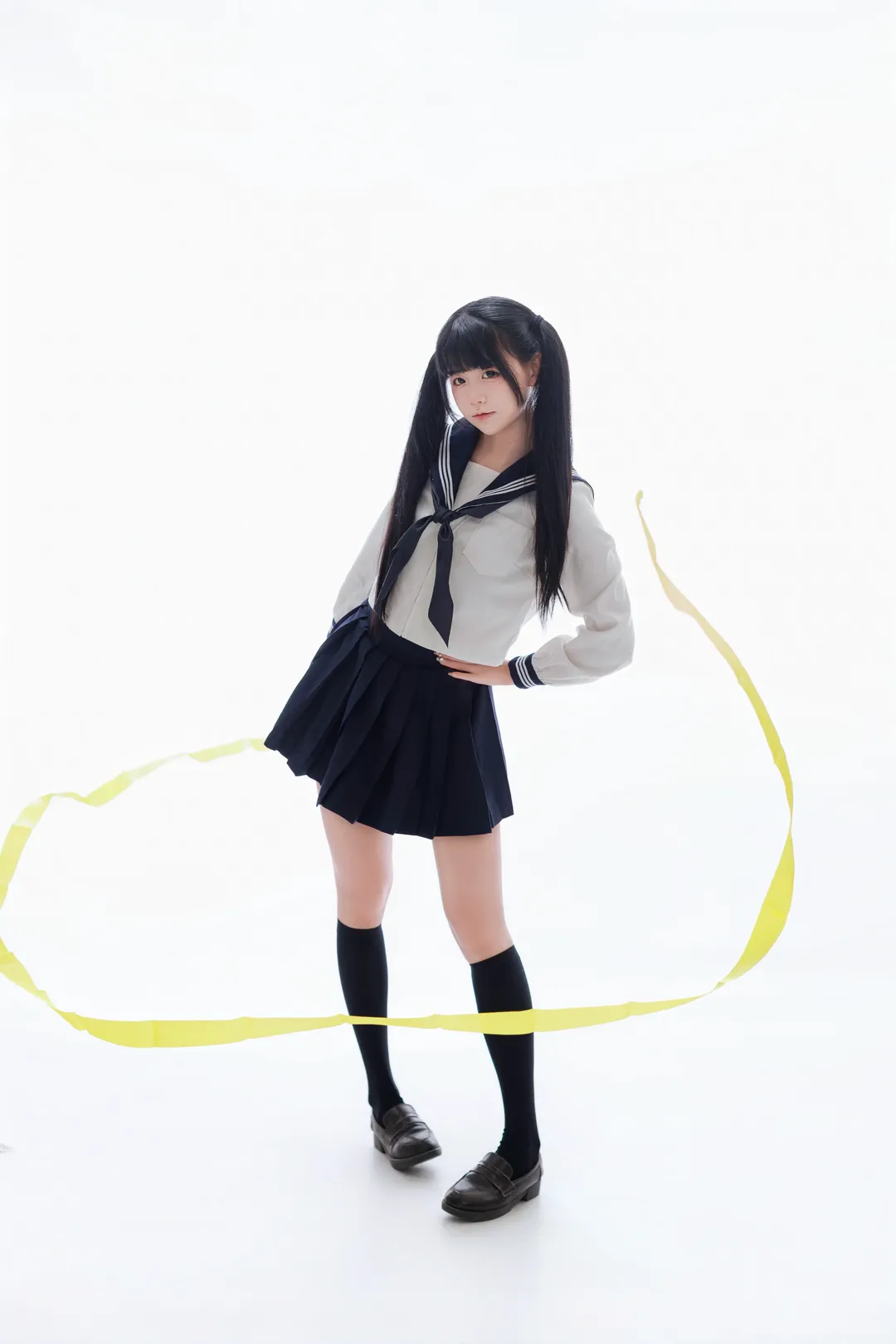
Once the white studio's lighting turned on, this combination of the sailor suit and the yellow gymnastics ribbon directly cut to the theme, aiming to nail a crisp and neat dynamic feel.
When it comes to JK uniforms, people usually associate them with quiet, artistic, or campus daily life. But this time I wanted to break that stereotype. The tailoring of the sailor suit is clean and sharp, and the stiff fabric of the pleated skirt makes it very easy to produce visual effects during movement. Paired with black knee-high socks and loafers, the overall styling is visually very unified. To match the jumping and large-scale movements, I made some adjustments to the inner wear to ensure the clothing wouldn't deform during intense exercise while maintaining the youthful lines of the sailor suit itself. The advantage of white studio photography is that there is no cluttered background interference, and the contrast between the black stockings and the white background is extremely strong. When doing squats or single-leg standing movements, the leg lines naturally stretch. To make the visual center of gravity more concentrated, the arc of the skirt hem is also key; wind that is too strong or movements that are too stiff will destroy the layering of the pleated skirt.
The yellow gymnastics ribbon chosen this time is the soul of the entire set of photos. It looks light, but making it behave is not so easy. The gymnastics ribbon relies heavily on the deft strength of the wrists and arms; if you rely only on brute force when making movements, the ribbon will quickly wrap around your body into a mess of tangled threads. When I first tried high kicks and bending over movements, the trajectory of the ribbon was always out of control. The photographer continuously adjusted the shutter speed nearby, and the lighting in the white studio was very sufficient; even a slight blur would make the image look dirty. We tried several action references, from simple straight-line pulling to slowly finding the rhythm of rotation. That high-leg-raise moment in Figure 1 actually required core tightening, while the left hand also had to control the long pole so that the ribbon formed a natural angle in the air. We tried this freeze-frame repeatedly several times to capture the most expansive frame.
Cooperation with the photographer is very important. Because the shooting is done in a white studio, the light sources are all artificial, and tiny angle changes will lead to different light and shadow. We communicated many times about the prediction of movement amplitude and ribbon floating trajectory. For example, making the ribbon wrap around the waist to form a perfect closed loop requires finding the exact moment in dynamics; camera snapshot, ribbon drooping, and slight body side-turn—these three elements are indispensable. Another example is holding the long pole with the ribbon horizontal across the chest, or standing with one hand on the hip and looking up; these seemingly casual poses actually require continuous muscle exertion to maintain stability. The wrinkles of the clothing, the direction of the ribbon, and the angle of the legs must be repeatedly confirmed in the viewfinder.
After finishing this set of pictures, I feel I have a new understanding of dynamic control. Blending clothing, props, light, shadow, and movement into the frame and achieving the desired effect is a very fulfilling process. If there is an opportunity later, I would like to try more prop and clothing combinations of different materials to explore more shooting possibilities.